The Short Answer: What TV Mounting Costs in Utah Right Now
Here is the honest version. For a standard TV mount on a normal drywall wall with studs, you should expect to pay a flat rate in the ballpark of $150 to $250 depending on TV size and the mount you already own. That lines up with the 2026 national numbers, where professional TV mounting runs about $150 to $350 with most homeowners landing around $250. Utah is not a cheap-labor state anymore, so treat the middle of that range as normal here rather than the floor.
At Cam's Custom AV, most straightforward mounts are a flat price, not an hourly meter running while you watch. You know the number before I show up. Where it moves to my $100/hour custom rate is when the job stops being 'hang a bracket on studs' and becomes real work: fishing wires inside a wall, mounting to brick or stone over a fireplace, cutting in a new recessed outlet, or engineering a full-motion arm to carry a heavy set safely. Those are genuinely different jobs, and pretending an 85-inch TV over a rock fireplace is the same $99 special as a 43-inch in a bedroom is how people get burned.
The reason a flat price works for the simple stuff is that a clean drywall mount is predictable. Find the studs, level the bracket, torque the lags, hang the TV, done. The reason the harder stuff is hourly is the opposite: I do not know what is behind your wall until I open it, and I would rather charge you for the actual time than pad a flat quote to cover a worst case that may not happen. That is the trade-off, and it is worth understanding before you compare quotes.
Takeaway: budget $150 to $250 for a basic mount and expect $100/hour for anything involving wire concealment, masonry, electrical, or full-motion hardware. If a quote is dramatically below that, ask what they are skipping.
What Actually Drives the Price Up
Four things move a TV mount from a flat rate into custom-work territory, and it helps to know each one so a quote makes sense. The first is in-wall wire concealment. Running the HDMI, power, and low-voltage cables inside the wall so nothing dangles is the single most requested upgrade, and nationally it adds roughly $150 to $300 - sometimes more on tricky walls. It is not just aesthetics; loose cables behind a TV are a snag hazard and a dust magnet. The catch is that code does not let you run a standard TV power cord inside a wall cavity, which is why a proper job uses a recessed power kit (an in-wall rated bridge) rather than stuffing the factory cord into the drywall.
The second driver is a new outlet behind the TV. If there is no receptacle where the screen will sit, you either fish power up to a code-compliant recessed kit or bring in an electrician to add a dedicated outlet, which runs about $150 to $300 on its own. Third is mount type: a fixed bracket is fast, but a full-motion articulating arm that swings and tilts is heavier, needs more anchoring, and takes longer, so it costs more in both hardware and labor. Fourth is wall material. Studs and drywall are easy. Brick, stone, tile, and plaster-and-lath all mean masonry bits, anchors, dust control, and time.
The most expensive combinations stack these together. An 85-inch TV over a brick fireplace with wires hidden in the wall is a multi-hour project - the industry pegs jobs like that at three to four hours - because you are drilling masonry, managing a 100-pound-plus screen, and solving the power problem all at once. That is exactly the kind of job my hourly custom rate exists for, and it is money well spent versus a cracked screen on the hearth.
Takeaway: price scales with concealment, electrical, mount type, and wall material. Tell your installer up front whether you want wires hidden and what the wall is made of - that determines whether you are looking at a flat rate or custom work.
The Over-Fireplace Question (Utah's Most Common Request)
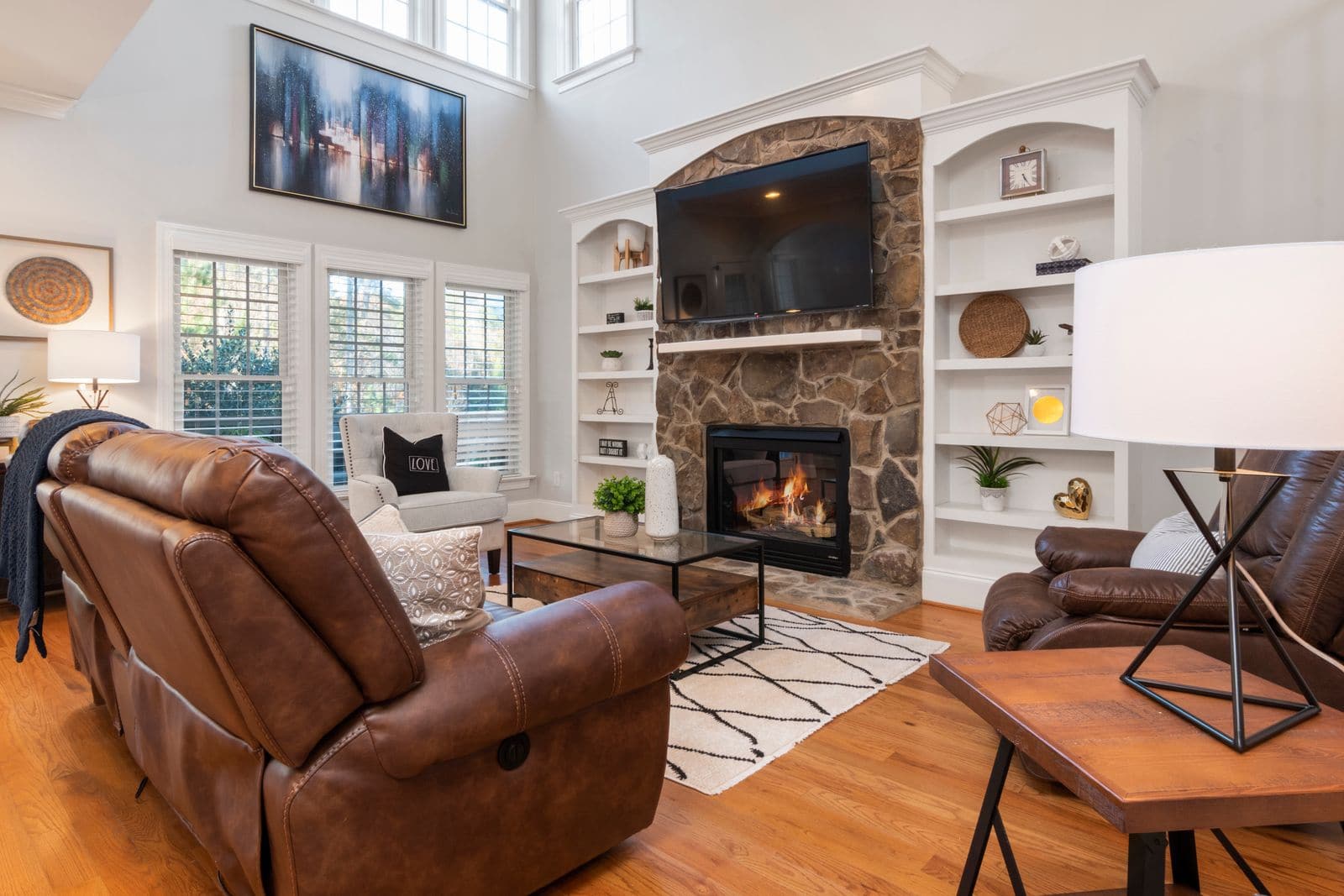
In Utah's newer homes, the great room fireplace is often the only wall built for a big screen, so over-fireplace mounting is the request I get most. It can absolutely be done well, but two problems have to be solved, and the cheap-install crowd ignores both. Problem one is heat. Most TVs are rated to operate up to roughly 90 to 100 degrees Fahrenheit, and a gas or wood fireplace can push the space above the mantel well past that. Sustained heat causes discoloration, dead pixels, and premature failure - and heat damage is usually not covered by the manufacturer warranty because it counts as misuse. The fix is real clearance, a mantel or recessed alcove to deflect heat, and on hot-burning units a heat shield.
Problem two is ergonomics. Mount a TV too high and everyone in the room cranks their neck up to watch, which spine specialists link to neck strain and muscular imbalance over time. A fireplace naturally pushes the screen higher than ideal, so the smart solution on many great rooms is a pull-down mount that keeps the TV tucked up when off but drops it to near eye level when you are actually watching. Those mounts (think MantelMount-style pull-down arms) cost more and take longer to install, but they solve the exact reason people regret over-fireplace TVs.
There is also the pure physics of it. A modern 85-inch TV can top 100 pounds, and hanging that much weight off masonry, or off a heavy pull-down arm, is not a job for four plastic drywall anchors. It needs the right masonry anchors driven into solid material, or lag bolts into blocking - which is one more reason over-fireplace work is custom, not flat-rate. When someone quotes an over-fireplace mount at the same price as a bedroom TV, they are almost always planning to skip the heat clearance, the pull-down hardware, or proper anchoring. Sometimes all three.
Takeaway: over-fireplace mounting is worth doing right - proper clearance for heat, a pull-down mount for viewing height, and real anchors for the weight. Expect it to be a custom job, not a cheap flat special.
Why Cheap Handyman Mounts Fail
This is the part people wish they had read first. Screws driven into drywall alone hold only about 5 to 10 pounds each before they tear out, and most 55-inch TVs already weigh 35 to 50 pounds. A 65-inch commonly runs 50 to 60 pounds, and 75-inch and 85-inch sets climb to 80 and 100-plus pounds. When a mount is not anchored into the wood studs or into proper structure, it is only a matter of time. The failure is rarely instant - the anchors creep, the drywall crumbles, and then a slammed door or a kid tugging a cable brings the whole thing down. The industry is full of the same story: a 65-inch on plastic anchors that let go at 2 a.m. and took a chunk of wall with it.
The other quiet failure is the wrong mount for the wall or the weight. A full-motion arm creates leverage - the TV cantilevers out and multiplies the load on the top fasteners - so it demands solid stud or masonry anchoring every time, no exceptions, regardless of TV size. Plaster-and-lath walls, common in older Salt Lake City and Provo homes, are another trap; they look solid but crack and pull out under load. A rushed installer who does not find real structure, or who splits a mount across a stud and an anchor, is building a slow-motion accident.
What you are actually paying a professional for is the boring, invisible stuff: locating the real studs (which are frequently not where the cheap guy guesses), using lag bolts into wood or rated masonry anchors, distributing load correctly, and matching the mount to both the wall and the TV's weight. That is the difference between a $1,800 TV that lives on the wall for a decade and one that ends up on the floor with a dinner-plate hole in the drywall behind it. The repair - new TV, drywall patch, paint - costs far more than doing the mount right the first time.
Takeaway: the cheapest quote is often the most expensive outcome. Insist on stud or masonry anchoring, the correct mount for your TV's weight, and never let anyone hang a large or full-motion TV on drywall anchors alone.
The Utah Context: New Homes, Bare Walls, and Why This Matters Here
Utah's growth is the backdrop to all of this. Utah County added nearly 16,000 residents in a single year - more than any other county in the state - and is projected to roughly double to around 1.5 million people between 2025 and 2065. Saratoga Springs grew about 8.4 percent in a year, and Eagle Mountain hit an estimated 76,695 residents in early 2026 while still growing over 6 percent annually. That is a staggering amount of brand-new construction in Lehi, Saratoga Springs, and Eagle Mountain, and every one of those homes has fresh drywall and a great room waiting for a TV.
New construction is a double-edged sword for mounting. On the good side, the walls are clean, the studs are straight, and if you catch a home during the build it is easy to pre-wire and add outlets before the drywall goes up. On the not-so-good side, tract homes are framed fast, blocking behind the fireplace is inconsistent, and the 'obvious' spot for the TV is almost always over a gas fireplace - which drops you straight into the heat and height problems above. Knowing what is behind a Lehi builder's wall is half the job.
The Silicon Slopes effect matters too. A lot of these buyers are tech and finance households furnishing large great rooms with large TVs - 65 inches is now the most popular size sold, and 75- and 85-inch sets are common in these homes. Bigger screens mean more weight, more concealment expectations, and higher stakes if the mount fails. This is a market where doing it correctly is not a luxury; it is matched to the size of TV people are actually buying here.
Takeaway: if you are in a new build in Utah County, mount early and pre-wire if you can - and assume the great room fireplace wall needs a real plan, not a builder-grade guess.
How to Read a Quote and Not Overpay
A trustworthy quote tells you three things clearly: the flat price for the base mount, the hourly rate for anything custom, and exactly which extras apply to your job. If someone gives you one suspiciously low number for 'everything,' ask them to itemize wire concealment, any outlet work, the mount hardware, and the wall type. Vague all-in pricing is where either surprise upcharges or skipped steps hide. My approach is simple: standard mounts are a published flat price, and custom work - concealment, masonry, electrical, full-motion, over-fireplace - is $100/hour so you only pay for the time the hard parts actually take.
Watch for the tells of a cut-rate job. No question about your wall material means they are not planning to anchor properly. No mention of studs or a stud finder means they may lean on drywall anchors. On an over-fireplace request, no discussion of heat clearance or viewing height means they are just slapping a fixed bracket up high and leaving you with a neck ache and a warranty risk. And be wary of running a factory power cord inside the wall - it is a code violation, and a real installer uses a recessed power kit instead.
One more piece of straight talk: buying your own mount is fine and often saves money, but buy the right one. A cheap fixed bracket is fine for a small bedroom TV on studs; a heavy or over-fireplace TV wants a quality full-motion or pull-down mount rated well above the TV's weight. If you are unsure, ask before you buy - matching the mount to the wall and the TV is exactly the kind of thing an owner-operator will tell you honestly, because I am the one who has to stand behind the install.
Takeaway: demand an itemized quote, a clear flat-versus-hourly split, and specific answers about anchoring and heat. Honest pricing is detailed pricing.
Want a straight quote for your place? Text or call Cameron at 801-735-8056 — usually back to you within the hour.