The Short Answer: What a Home Theater Costs in Utah County
Here is the honest range, and I will not bury it. Most of the home theaters we build in Utah County land between $15,000 and $60,000. A clean, simple setup, think a nice projector, a good screen, a solid 5.1 or 7.1 sound system, and a comfortable seating area, can start around $10,000. On the other end, a fully dedicated luxury theater with tiered seating, professional acoustic treatment, a $30,000 projector, and Dolby Atmos speakers built into the walls and ceiling can climb to $100,000 and, at the extreme, past $500,000. Those half-million-dollar rooms are real, but they are rare. Nationally, industry cost data puts the average full home theater install around $20,000, with the typical project spanning $10,000 to $60,000. That tracks almost exactly with what I see here on the Wasatch Front.
Why such a wide range? Because a home theater is not one product, it is a system of choices. A living-room setup where we mount a 75-inch 4K TV, add a soundbar or a discreet in-wall speaker system, and clean up the wiring is a fundamentally different job than framing out an unfinished basement room, soundproofing it, treating the acoustics, and calibrating a projector to a fixed screen. The equipment matters, but so does the room, the wiring, and the labor to make it all disappear into the walls.
Where your project lands comes down to five things: the display (TV versus projector and screen), the sound system, the seating, the room itself (acoustics and soundproofing), and the install labor. I will walk through each one with real numbers so you can build your own estimate before you ever call anyone. Takeaway: if someone quotes you a single number without asking about your room, your budget, and how you actually watch, be skeptical. A real quote is a conversation, not a price tag.
What Actually Drives the Cost
The display is usually the first big fork in the road. A quality 65 to 75-inch 4K TV runs $800 to $3,000 and needs no dark room, no screen, and minimal fuss, which is why it is the smart choice for a bright, multi-use family room. A projector-and-screen combo is where you get that true cinema feel, and it runs $2,500 to $15,000 depending on brightness, resolution, and screen size. A good fixed 120-inch screen alone starts around $2,000, with excellent ones a bit over $3,000, and a top-tier laser projector can run $5,000 to $30,000 by itself. Projectors want a dark, controlled room to look their best, so this choice often decides whether you are finishing a basement or working in an existing living space.
Sound is where a theater actually becomes a theater, and it is easy to underspend here. A decent 5.1 surround system starts around $1,000. Step up to a premium in-wall or in-ceiling Dolby Atmos configuration with multiple subwoofers and you are at $10,000 or more. The speakers themselves are only part of it, you also need an AV receiver or separate processor and amplifier, which can run anywhere from $700 for a solid receiver to $15,000-plus for separates in a high-end room. My advice: put real money into the sound. People think they are buying a picture, but they remember how the room felt, and that is the speakers and the subwoofer doing the work.
Seating and the room finish round it out. Power-reclining theater chairs run $500 to $1,500 each and, done right, need floor outlets and sometimes a raised riser for a second row, so a four-to-six-seat setup is often a $3,000 to $9,000 line item, with fully custom luxury seating reaching $20,000. Acoustic treatment can be as little as $500 for a few basic panels or $10,000 to $30,000 for a professionally designed room, and treating the walls of a typical dedicated theater in materials alone runs roughly $2,800 to $6,600. Soundproofing so the movie does not wake the kids upstairs typically costs $1,000 to $10,000, usually around $6 to $12 per square foot for mid-range work. Takeaway: the TV or projector gets the attention, but seating, acoustics, and soundproofing quietly account for a huge share of the budget in a dedicated room, and skipping them is the most common regret I hear about.
Labor and Wiring: The Part People Forget
Equipment is what you can see in the catalog. Labor is what makes it work and disappear into the walls, and it is the line item homeowners underestimate most. My shop rate is $100 per hour, which is a fair, owner-operated rate for Utah County. For complex jobs, running wire through finished walls, building in a projector mount and lift, integrating lighting control and a universal remote, calibrating a projector, other outfits charge $100 to $200 per hour. On a full dedicated theater, labor can run from a couple thousand dollars up to well over $10,000 depending on how much building and integration is involved.
The single biggest labor variable is whether the walls are open. If we are working in new construction or an unfinished basement, we can pre-wire everything before drywall goes up, speaker wire, HDMI, network drops, conduit for future upgrades, and it is fast and clean. Retrofitting the same wiring into a finished, drywalled room means fishing cables, cutting and patching, and a lot more hours. This is exactly why Utah County's building boom matters for your budget: if you are building or finishing a basement, pre-wiring for a future theater is the cheapest money you will ever spend, often a few hundred dollars in wire and an hour or two of labor that saves thousands later.
Calibration and integration are the invisible costs that separate a good theater from a great one. A projector straight out of the box is not accurate, and a surround system that has not been tuned to the room will sound muddy. Professional calibration and control integration, making one button dim the lights, drop the screen, and start the movie, is where the labor hours add up, and it is genuinely worth it. Takeaway: budget 20 to 35 percent of a full dedicated-theater project for labor and integration, and if your home is being built or your basement is unfinished, pre-wire now even if the theater is years away.
Example Builds at Three Real Budgets
The Starter Theater, around $10,000 to $15,000. This is the living-room or bonus-room build. A quality 75 to 85-inch 4K TV ($1,500 to $3,000), a real surround system rather than a soundbar, in-wall speakers with a proper receiver and subwoofer ($2,500 to $4,000), clean in-wall wiring, and a couple of nice recliners. We hide the cables, mount everything solidly, and calibrate the sound. No room construction, no soundproofing, just a great-looking, great-sounding space in a room you already have. This is where most first-time buyers should honestly start.
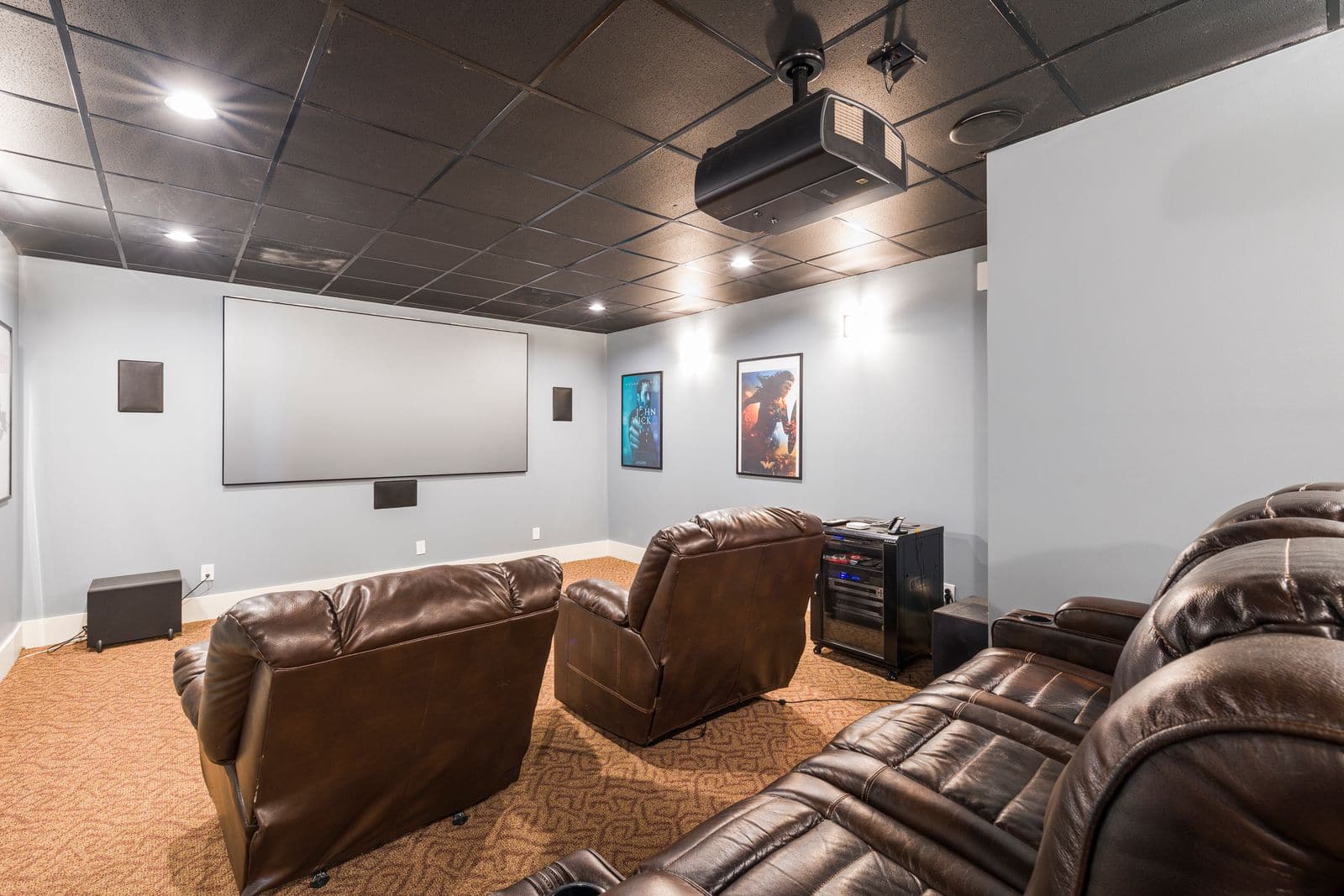
The Sweet Spot, around $25,000 to $40,000. This is the dedicated room in a finished or finishing basement, and it is where most of my Utah County clients land. A laser projector and a 120-inch fixed screen ($6,000 to $12,000), a 7.1 or Atmos in-wall and in-ceiling speaker system with dual subwoofers ($5,000 to $9,000), acoustic panels and bass traps, basic soundproofing so it does not bleed through the house, four to six power recliners on a two-row layout, dimmable lighting control, and full calibration. Nationally a 300-to-400-square-foot room with mid-range gear runs about $25,000 to $40,000, which matches what we build here almost dollar for dollar.
The Luxury Theater, $75,000 to $500,000-plus. This is a purpose-built room, often designed alongside the home. Think a reference-grade projector or a large direct-view LED wall, a fully acoustically engineered room with soundproof construction, tiered seating on custom risers, motorized everything, a dedicated equipment rack, and integration with the whole-home automation system. The half-million-dollar figure is real for the top of this tier, but the vast majority of luxury builds land in the $75,000 to $150,000 range. Takeaway: pick the tier that matches how you actually live, an honest $30,000 dedicated theater beats a compromised $80,000 one, and you can always pre-wire so an upgrade later is painless.
Why Utah County Is a Uniquely Good Place to Build One
Utah County is in the middle of a historic construction boom, and that changes the math on home theaters. Lehi has grown to more than 90,000 residents. Saratoga Springs jumped from roughly 37,700 people in 2020 to over 52,000 by 2024, and Eagle Mountain went from about 43,620 to 60,600 in the same span. The state is pouring roughly $2.1 billion into roads and infrastructure across that northwest Utah County corridor through the end of the decade. Translation: a lot of new homes with large, unfinished basements are going up right now near Silicon Slopes.
That new-construction wave is the single best cost-saving opportunity a homeowner can catch. An unfinished basement is a blank canvas, we can frame the room to the right proportions for sound, insulate for soundproofing, and pre-wire everything before a single sheet of drywall goes up. Doing it at the build stage can cut the labor cost of a dedicated theater dramatically compared to gutting a finished room later. If you are closing on a new build in Lehi, Saratoga Springs, or Eagle Mountain, the smartest move is to have the wiring roughed in during construction even if the theater itself is a phase-two project.
There is also a local reality worth naming: many Silicon Slopes households have the income and the home size for a serious theater, and interest in dedicated rooms here is high. But that also means there are plenty of quick-install outfits chasing the boom. As an owner-operated shop, I am the one who quotes your job, runs the wire, and calibrates the room, which is the opposite of the crew-of-the-week experience. Takeaway: if you live in the northwest Utah County growth corridor, your timing is excellent, pre-wiring during construction is the highest-return decision in this entire guide.
How to Save Money Without Cutting Corners
The best savings come from sequencing and DIY on the parts that do not need a pro. If you are handy, you can absolutely place a freestanding projector or hang a new TV and connect speakers yourself, which can save $1,500 to $2,000 in labor. Where you should not cut corners is anything inside the walls or anything that needs calibration, a badly fished HDMI run or an untuned surround system is expensive to fix and ruins the experience you paid for. Do the visible, reversible work yourself and hire out the wiring, mounting, and tuning.
Pre-wiring is the highest-leverage move, and I will keep hammering it because it is that important. A few hundred dollars of speaker wire, HDMI, and conduit run before drywall can save thousands in retrofit labor down the road. Right behind it: phase your build. Get the room, the wiring, and a good display and sound system in place first, then add the luxury seating, second subwoofer, acoustic panels, and lighting automation over time as budget allows. A theater that is 80 percent done and paid for beats one you stretched to finish all at once.
Finally, spend where it actually shows and save where it does not. Put your money into the sound system and the screen, that is what people feel. Save on the projector by choosing a strong mid-tier laser model instead of a reference unit, save on seating by buying quality direct-to-consumer recliners at $769 to $949 a seat instead of $1,200-plus retail, and use a mix of professional acoustic panels and DIY-friendly treatment. Takeaway: the goal is not the cheapest theater or the most expensive one, it is the one where every dollar you spent is a dollar you can hear and see, and an honest local installer will tell you where those dollars are.
Want a straight quote for your place? Text or call Cameron at 801-735-8056 — usually back to you within the hour.