The Short Version: Yes, Your HOA Can Weigh In — But It's Narrower Than You Think
Here's the honest answer most articles bury: in Utah, your HOA almost never bans security cameras outright, but it can absolutely regulate how they attach to your house and where they point. That distinction is the whole ballgame. A camera sitting inside your window looking out is your business. The moment you drill into brick, run exterior conduit, mount a floodlight cam under the eave, or swap your builder-grade doorbell for a video one, you've made an 'exterior modification' — and in most Utah master-planned communities, exterior modifications need architectural approval before you start.
The legal backbone here is the Utah Community Association Act (Utah Code Title 57, Chapter 8a). It lets HOAs enforce their recorded CC&Rs and design guidelines, including rules about the appearance of anything mounted on the outside of your home. That's why a camera can be legal under state privacy law and still get you a violation letter — the HOA isn't objecting to surveillance, it's objecting to an unapproved thing bolted to your façade. We see this constantly in newer Utah County and Salt Lake County builds where the design standards are strict and freshly written.
One important myth to kill early: the FCC's OTARD rule (47 C.F.R. § 1.4000), which protects satellite dishes and TV antennas from unreasonable HOA restrictions, does NOT cover security cameras. Cameras aren't 'over-the-air reception devices.' So don't quote OTARD to your board — it won't help, and it makes you look like you Googled for five minutes. Your real protections come from state law and from the HOA's own duty to enforce its rules reasonably and consistently.
Takeaway: Assume the camera itself is fine, but the mounting and aim are what the HOA controls. Plan to get approval for anything you screw into the exterior, and you'll skip 90 percent of the headaches.
What Utah HOAs Actually Restrict (Exterior Mounting, Aim, and Privacy)
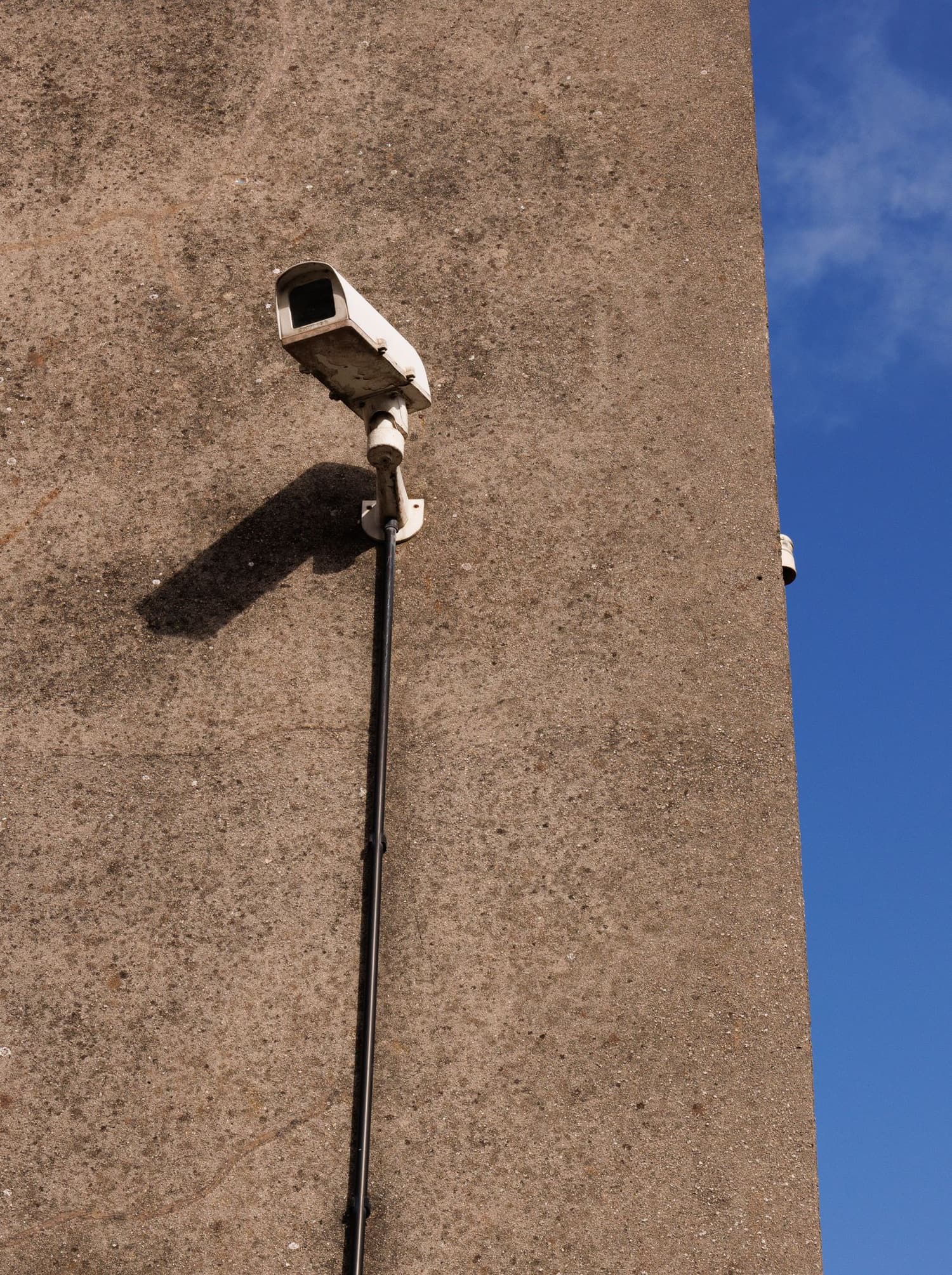
After years of installs from Lehi to Herriman, the restrictions we run into cluster into three buckets. First, exterior mounting and appearance: many guidelines want cameras in a color that matches the trim or fascia, want wiring hidden (no exposed cable stapled down the stucco), and prohibit large, industrial-looking housings on the front elevation. A discreet bullet cam tucked under the eave sails through; a bright white PoE turret dangling off the front gable on visible cable gets flagged.
Second, camera aim and coverage. HOAs increasingly write rules that your cameras can't be pointed into a neighbor's windows, fenced backyard, or other areas where people reasonably expect privacy, and that you generally can't surveil common areas — pools, clubhouses, shared trails — because that's the association's job, not an individual owner's. A doorbell cam covering your porch and the public sidewalk is standard and fine. A pan-tilt-zoom on your second story that can sweep the neighbor's hot tub is the kind of thing that generates complaints and, in Utah, can cross into actual legal exposure.
Third, the approval process itself. In communities like Daybreak (South Jordan), any exterior change goes to the Design Review Committee first — you submit online, sometimes pay a fee, and wait for written approval before touching a drill. Daybreak's committee meets the first and third Wednesday of each month, and their published fees run roughly $75 for something like solar up to a couple hundred dollars for major architectural modifications. Smaller HOAs in Saratoga Springs, Eagle Mountain, and Herriman may just require an Architectural Review form and a photo, but the principle is identical: approval before installation, not after.
Takeaway: Match the finish, hide the wiring, aim only at your own property and shared entry points, and file the paperwork first. Those four moves resolve nearly every camera dispute we've seen.
Utah Law Basics: Recording, Consent, and the Voyeurism Line
Utah is a one-party consent state for recording (Utah Code § 77-23a-4). In plain terms, you can record a conversation you're part of, and video of public spaces is generally fair game — your neighbor can film the street, and you can film your porch and the sidewalk. The catch is audio. Many outdoor cameras record sound by default, and if a camera captures private conversations of people who reasonably expect privacy (say, guests talking on a fenced patio), you can wander into interception territory. The penalty for illegal interception in Utah is not trivial: it's presumptively a third-degree felony, up to five years and a $5,000 fine. For most homeowners, the smart move is to disable audio on any camera whose sound might reach a neighbor's private space.
The hard line is voyeurism. Under Utah Code § 76-12-307, aiming a camera to secretly capture someone where they have a reasonable expectation of privacy — bathrooms, bedroom windows, changing areas, a fenced yard through a gap — is a crime regardless of whether audio is recorded. This is the one place a camera stops being an HOA design question and becomes a criminal one. No approval form protects you from pointing a lens somewhere it legally shouldn't go.
It's worth being clear-eyed that Utah's privacy statutes were written before modern doorbell and AI cameras, so a lot of gray area gets settled by common sense and neighbor goodwill rather than bright-line rules. Courts and boards both tend to reward homeowners who obviously tried to be reasonable — cameras aimed down at their own driveway and entry, audio off where it matters, privacy zones enabled in the app to gray out a neighbor's window.
Takeaway: Public-facing video is legal; secretly recording private spaces is not. Turn off audio near property lines, use software privacy masks, and you stay comfortably on the right side of both the HOA and the criminal code. (General information, not legal advice — check your specific CC&Rs and consult an attorney for your situation.)
How to Place Cameras So You Pass Design Review the First Time
The install choices that keep you compliant are almost all about restraint and cleanliness. Mount under the eaves and soffits rather than face-drilling into brick or stucco — it looks intentional, it's weather-protected, and it reads as part of the house instead of an add-on. Choose housings in black or a color that matches your trim, and on the front elevation lean toward the smallest camera that does the job. A low-profile doorbell and a discreet eave cam over the garage cover the two highest-value angles (front door and driveway) without ever drawing a complaint.
Wiring is where DIY jobs get caught. Exposed cable running down an exterior wall is the single most common reason a camera install looks 'unapproved,' even when the camera itself is fine. Running low-voltage cable through the attic and soffit, or in paintable conduit color-matched to the wall, is the difference between a clean approval and a redo. This is genuinely most of what a good local installer is charging you for — not the camera, the concealment.
Set up software privacy zones on day one. Every serious camera platform (Reolink, Lorex, Ubiquiti, Ring, and the pro NVR systems we install) lets you black out portions of the frame. Mask any sliver of a neighbor's window or yard before you ever save a recording. If a neighbor complains to the board, being able to show a masked feed ends the conversation immediately. Keep coverage to your own lot plus the public approach, and you satisfy both the HOA aim rules and the state privacy line at the same time.
Takeaway: Under-eave mounting, hidden wiring, trim-matched housings, and privacy masks are the four-part recipe. Do all four and design review becomes a formality rather than a fight.
Why This Matters More in Utah's Boom Cities Right Now
Utah's Silicon Slopes growth corridor has created a very specific situation: tens of thousands of brand-new homes in strict, freshly-governed HOAs where the design standards are aggressively enforced because the community is still being built out. Saratoga Springs hit roughly 66,000 residents in 2026 with around 7.7 percent annual growth, and Eagle Mountain and Saratoga Springs have each added more than 14,000 people since 2020. Herriman has grown well over 100 percent in the last decade. When a neighborhood is that new, the developer-controlled HOA tends to police exterior consistency hard to protect resale value and the community 'look.'
Practically, that means new-construction buyers in Lehi, Saratoga Springs, and Eagle Mountain are far more likely to hit a design review committee than someone in an older, established Salt Lake neighborhood with no HOA at all. The rules aren't necessarily harsher — they're just actively enforced, with committees meeting on a set schedule and design managers who follow up. We plan every install in these areas assuming approval is required, because it almost always is.
There's also a density factor. New Utah subdivisions are built tight — narrow side yards, homes close together, shared-looking spaces. That geometry makes it physically easy for a camera to catch a neighbor's window or yard by accident, which is exactly what triggers both complaints and privacy issues. Thoughtful aim and privacy masking matter more here than they would on a half-acre lot in a rural county.
Takeaway: If you're in a post-2020 build along the Point of the Mountain or in northwest Utah County, treat HOA approval as mandatory and plan camera aim carefully for tight lots. The community is watching, and so is the design committee.
The Approval Playbook, Fines, and What It Costs
The path to a clean approval is short if you do it in order. Pull your CC&Rs and architectural/design guidelines (usually on the HOA portal or from the management company) and search for 'exterior modification,' 'cameras,' and 'antenna.' Then submit an architectural request with a simple site plan or marked-up photo showing where cameras go, the model and color, how wiring is concealed, and the direction each camera faces. Communities like Daybreak require this online before any work begins; many Saratoga Springs and Herriman HOAs use a one-page form. Wait for written approval, then install.
If you skip approval, Utah's enforcement process is real but structured in your favor. Under Utah Code § 57-8a-208, the HOA generally must give written warning and at least 48 hours to cure a continuing violation before fining you, and if you're fined you can request an informal hearing within 30 days. Utah sets no statutory dollar cap on fines, but they must be 'reasonable' and authorized by the governing documents — and you have appeal rights (up to 180 days to district court on a final decision). The takeaway isn't 'fines are scary,' it's 'the process gives you room to fix it,' so a good-faith homeowner who submits paperwork after the fact usually resolves things without a check ever being written.
On cost: professionally installed outdoor cameras in the Salt Lake and Utah County market generally run about $150 to $400 per camera installed, with a typical clean 4-to-8 camera home system landing somewhere between roughly $800 and $2,500-plus depending on wired-versus-wireless, cable runs, and whether you want a recording NVR. Hard-wired PoE systems cost more up front but are the most reliable and the hardest to defeat — and, relevant here, they're the ones that look cleanest to an HOA because the wiring is fully concealed.
Takeaway: Read the guidelines, submit before you drill, and budget for concealed wiring. That's the entire difference between a system that quietly protects your home for a decade and one that generates violation letters. When in doubt, an owner-operated local installer who knows the Daybreak, Saratoga Springs, and Herriman committees can handle both the install and the paperwork.
Want a straight quote for your place? Text or call Cameron at 801-735-8056 — usually back to you within the hour.